
The Short Answer
All-on-4® and Ultratooth® both provide qualified patients with fixed teeth without a long wait, but they are different treatments. All-on-4 is a full-arch treatment concept that replaces every tooth in one jaw with a single fixed bridge anchored on four implants. Ultratooth is an immediate-load implant system invented by Dr. Sargon Lazarof that can replace one tooth, several teeth, or a full mouth.
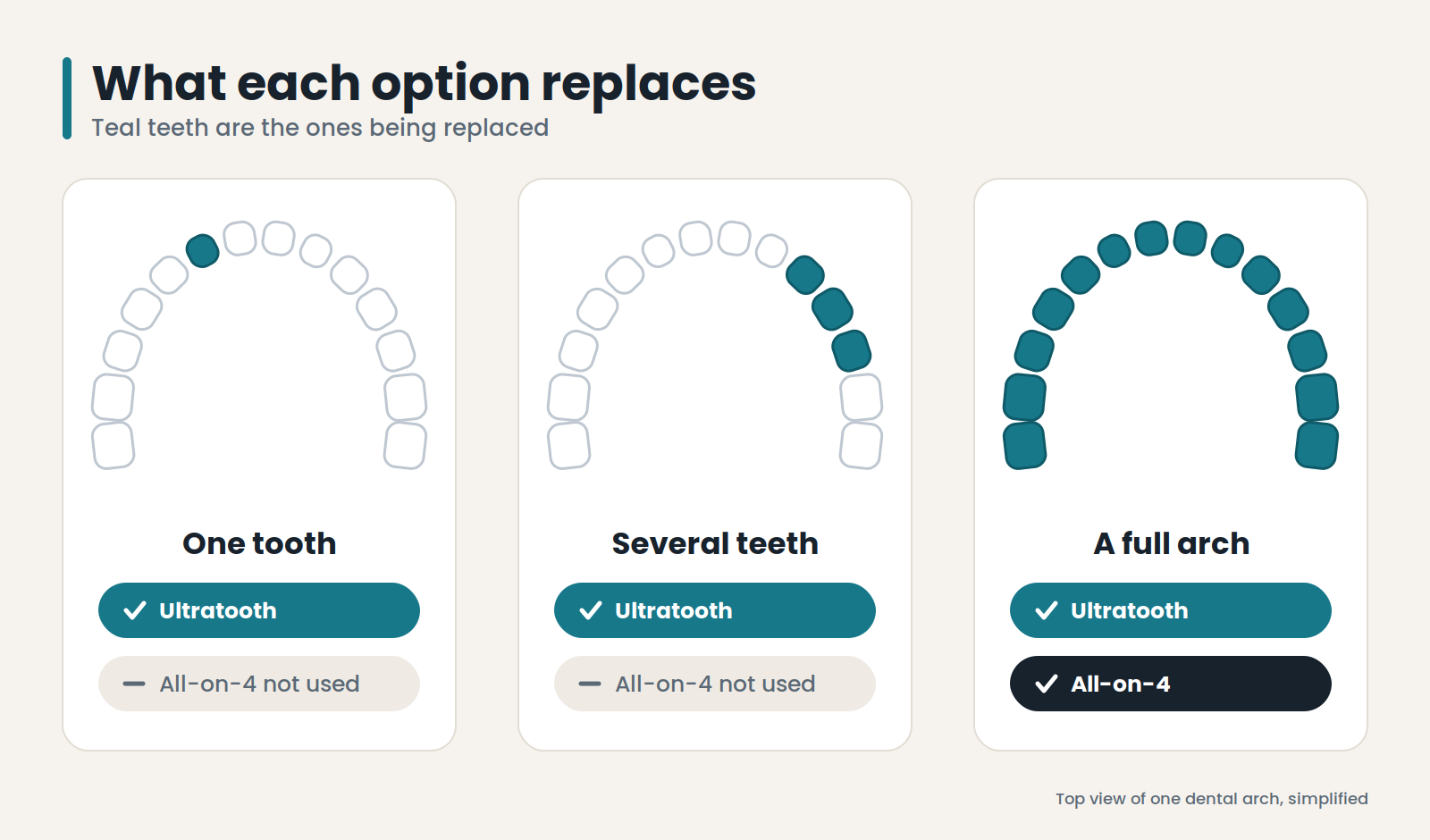
The biggest practical difference is scope. All-on-4 is designed for people who have lost, or are about to lose, all the teeth in an arch. Ultratooth restores only what is missing, so healthy teeth can stay in place.
The right choice depends on how many teeth need replacing, how much healthy bone remains, and what a full exam and 3D imaging show. Neither option suits every patient.
What Is All-on-4?
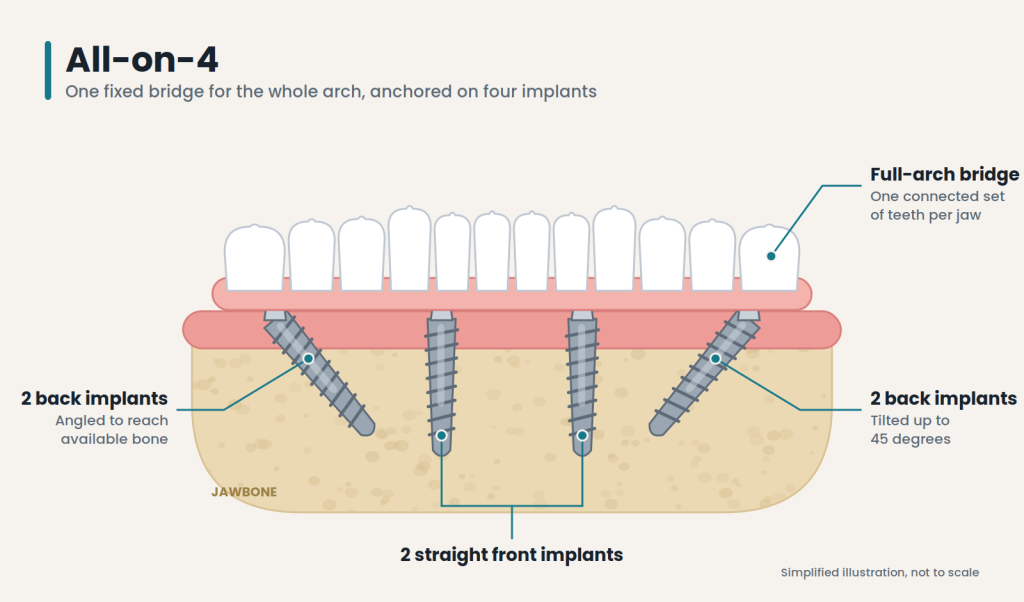
All-on-4 replaces a full upper or lower arch of teeth with one fixed bridge supported by four dental implants. Nobel Biocare introduced it with Dr. Paulo Maló, and the company reports more than 25 years of documented clinical use.
How All-on-4 Works
The name describes the design. All the teeth in the arch sit on four implants.
- Two front implants are placed straight into the front of the jaw, where bone is usually densest.
- Two back implants are tilted up to 45 degrees. The angle lets them reach available bone while steering around the sinus in the upper jaw and the nerve in the lower jaw.
- A single connected bridge attaches to all four implants. Patients who meet the criteria for immediate loading receive a provisional fixed bridge on the day of surgery.
- A final bridge replaces the provisional one after the implants have healed and bonded with the bone.
What to Know Before Choosing All-on-4
All-on-4 is a full-arch solution, so you remove any remaining teeth in that arch, even healthy ones. Some jawbone is often reshaped as well to make room for the bridge.
Because the bridge is one connected piece, all four implants share the load. If one implant or one section of the bridge has a problem, the repair can involve the whole arch.
Tilting the back implants often lets patients avoid bone grafting, which is why the concept is described as graftless. Nobel Biocare reports a mean implant survival of 98% with a mean follow-up of up to 7.5 years, based on its own data.
What Is Ultratooth?
Ultratooth is a patented immediate-load dental implant system invented and developed by Dr. Sargon Lazarof. It is built so that a qualified patient can receive an implant and a fixed temporary tooth in the same visit, as described on Sargon Dental’s immediate dental implants page.
How Ultratooth Works
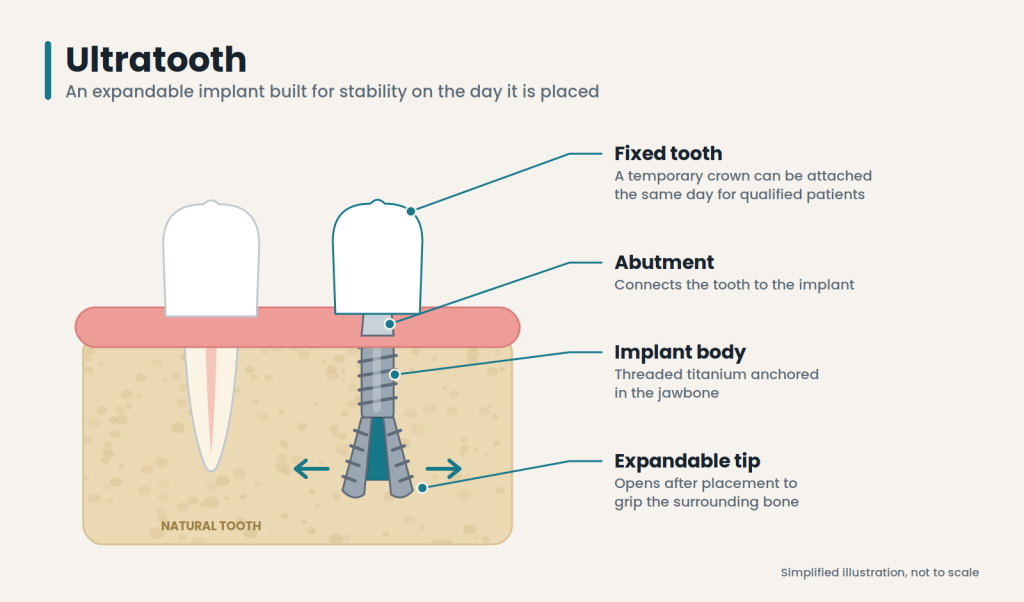
A conventional implant relies mainly on its threads for early grip in the bone. Ultratooth adds an expandable section at the implant tip.
- Placement. The clinician positions the implant in a carefully prepared site in the jaw.
- Expansion. The clinician activates the expansion mechanism, and the implant tip opens in a controlled way to engage the surrounding bone.
- Immediate tooth. When stability and other clinical criteria are met, the clinician attaches a fixed temporary tooth during the same appointment.
- Final restoration. Dr. Lazarof places the permanent tooth once the implant and tissues have healed.
What to Know Before Choosing Ultratooth
The Sargon Immediate Load Implant, Ultratooth Model, received FDA 510(k) clearance for immediate-load use in partially or fully toothless upper and lower jaws. That clearance includes support of free-standing restorations, meaning a single tooth that is not splinted to its neighbors.
Ultratooth is not limited to one type of case. It can replace a single tooth, support an implant bridge for several missing teeth, or anchor a full-mouth restoration.
Immediate loading does not skip biology. The implant is mechanically stable on day one, but bone and gum tissue still need time to heal, and not every patient or implant site qualifies.
All-on-4 vs. Ultratooth at a Glance
The two options differ most in how many teeth they replace and how the implant gains its early grip in the bone.
| Factor | All-on-4 | Ultratooth |
|---|---|---|
| Type of treatment | Full-arch treatment concept | Immediate-load implant system |
| Developed by | Nobel Biocare with Dr. Paulo Maló | Dr. Sargon Lazarof |
| Teeth replaced | Every tooth in one arch | One tooth, several teeth, or a full mouth |
| Implants used | Four per arch | Planned case by case, based on missing teeth, bone, and bite |
| How early stability is achieved | Threaded implants, with the two back implants tilted up to 45 degrees | Expandable tip activated by the clinician after placement |
| Same-day fixed teeth | Provisional full-arch bridge for patients who meet immediate loading criteria | Fixed temporary tooth for patients who reach adequate stability |
| Remaining healthy teeth | Removed in the treated arch | Can stay in place |
| Bone grafting | Often avoided by tilting the back implants | May be avoided in selected cases, still needed for some patients |
| Final restoration | One connected full-arch bridge | Individual crown, implant bridge, or full-arch restoration |
| If one tooth needs repair | Work can involve the whole bridge | Individual crowns can be treated one at a time |
| Where it is offered | Many implant practices | Sargon Dental in Encino |
Treatment Timeline From Consultation to Final Teeth
Both treatments can place fixed teeth on the day of surgery, but both still need months of healing before the final restoration. The same-day teeth are temporary in each case.
The All-on-4 Timeline
- Consultation and 3D imaging. The dentist measures bone, maps the sinus and nerve positions, and plans all four implant sites.
- Surgery day. Remaining teeth in the arch are removed, the four implants are placed, and a provisional fixed bridge is attached if stability allows.
- Healing. The implants bond with the jawbone over the following months while the patient follows a soft diet.
- Final bridge. A stronger permanent bridge replaces the provisional one after healing is confirmed.
The Ultratooth Timeline
- Consultation and digital planning. Dr. Lazarof reviews your medical history and imaging to choose the implant’s position, size, and type.
- Extraction when needed. A failing tooth is removed with care to preserve the surrounding bone and gum.
- Implant placement and expansion. The Ultratooth implant is positioned, and its expansion mechanism is activated to create primary stability.
- Immediate temporary tooth. A fixed temporary restoration is attached in the same visit when clinical criteria are met.
- Healing and follow-up. The implant is monitored while the patient follows diet and hygiene instructions.
- Final restoration. The permanent tooth is designed to match the surrounding smile and placed once healing is confirmed.
What Same-Day Teeth Really Means
A same-day tooth is a working placeholder, not the finished result. It fills the gap, supports speech and appearance, and is shaped to keep heavy chewing forces off the healing implant.
Patients in both groups are usually asked to eat softer foods at first. Too much pressure during healing can interfere with the bond between implant and bone.
Who Is a Good Candidate for Each Option?
Candidate selection depends on how many teeth are affected and what the bone and gums can support. A clinical exam and diagnostic imaging are required before recommending either treatment.
All-on-4 Tends to Fit Patients Who
- Have lost all or nearly all teeth in an upper or lower arch
- Have remaining teeth that are failing and cannot be saved
- Wear a removable denture and want fixed teeth instead
- Have bone loss in the back of the jaw, where tilted implants can help avoid grafting
Ultratooth Tends to Fit Patients Who
- Are missing one tooth or a few teeth and want to keep their healthy ones
- Have a damaged or infected tooth that needs extraction and want it replaced in the same visit
- Want to avoid a visible gap, especially for a front tooth
- Need a full-mouth restoration and prefer treatment from the dentist who invented the implant
What Dentists Evaluate for Both
No implant system removes the need for careful patient selection. Dr. Lazarof evaluates these factors before recommending immediate loading.
- Amount and quality of available bone
- Gum health and any active infection
- Location of nerves and sinuses
- Bite forces and tooth position
- Smoking history, medications, and medical conditions
- Willingness to follow post-operative instructions
When immediate loading isn’t the safest option, a staged implant approach with a longer healing period may provide a better long-term result.
Daily Life, Cleaning, and Long-Term Care
Both options are fixed in place and are not removed at night. The day-to-day difference is whether you care for individual teeth or one connected bridge.
Feel and Function
An All-on-4 bridge is a single unit that spans the arch and rests over the gums. Most patients adapt well, though the bridge can feel bulkier than natural teeth at first.
An individual Ultratooth restoration stands on its own implant, much like a natural tooth stands on its own root. Neighboring teeth are not ground down or connected to it.
Cleaning
A full-arch bridge has a small space between the bridge and the gums that traps food and plaque. Cleaning usually requires a water flosser, small brushes, or threaded floss, plus regular professional visits.
You brush and floss single implant crowns much like natural teeth. A full-arch Ultratooth restoration needs the same under-the-bridge care as any other fixed bridge.
How Long Each Option Lasts
Dental implants are designed as a long-term tooth replacement. How long they last depends on implant position, bone and gum health, bite forces, smoking, medical conditions, and home care.
Implants cannot get cavities, but the tissue around them can become inflamed. Plaque around an implant can damage the supporting gum and bone, so daily cleaning and routine checkups matter for both options.
Cost Factors to Compare
Neither treatment has a single price, because the fee depends on what each mouth needs. An accurate estimate requires an exam and imaging.
All-on-4 is usually quoted per arch. One fee typically covers the four implants, extractions, the provisional bridge, and the final bridge, so the material chosen for the final bridge strongly affects the total.
Ultratooth treatment is priced around the plan. Replacing one tooth costs far less than rebuilding a full arch, and patients who keep their healthy teeth pay only to replace what is missing.
These factors move the cost of either option.
- Number of teeth and implants involved
- Extractions and treatment of infection
- Bone grafting or sinus procedures, when needed
- Type and material of the final restoration
- Laboratory work and diagnostic imaging
- Sedation
- Experience of the treating dentist
When comparing quotes, look at the complete treatment, not just the implant price. Include diagnosis, surgery, temporary teeth, the final restoration, and follow-up care in your comparison. Sargon Dental reviews insurance and financing options during the consultation.
How to Choose Between All-on-4 and Ultratooth
Start with how many teeth truly need replacing. That one answer narrows the decision more than any other factor.
- You still have healthy teeth. An approach that replaces only missing or failing teeth, such as Ultratooth, lets you keep the rest. All-on-4 would require removing every tooth in the arch.
- You are missing one tooth or a few teeth. All-on-4 is not designed for this situation. Individual implants or an implant bridge are the usual options.
- You have no teeth, or none worth saving, in an arch. Both paths are worth discussing. Compare the number of implants, the type of final bridge, and how repairs would be handled.
- You were told you need bone grafting. Ask about both. Tilted implants and the Ultratooth expandable design each offer a way to work with existing bone in selected cases.
- A front tooth has to come out. Ask whether same-visit extraction, implant placement, and a temporary tooth are possible for your site.
Questions to Ask at Your Consultation
- Can any of my natural teeth be saved?
- How many implants do you recommend, and why?
- Do I qualify for a fixed temporary tooth on the day of surgery?
- Will I need bone grafting or a sinus procedure?
- What happens if one implant or one tooth has a problem later?
- What is included in the fee, from imaging to the final restoration?
Talk With the Inventor of Ultratooth
Dr. Sargon Lazarof, the dentist who invented the Ultratooth implant, evaluates patients at Sargon Dental. Schedule a consultation to find out which approach fits your mouth.
Sargon Dental Encino
16101 Ventura Blvd, Suite 350, Encino, CA 91436
Phone: (818) 380-9057
Frequently Asked Questions
What is the main difference between All-on-4 and Ultratooth?
All-on-4 is a full-arch treatment that places one fixed bridge on four implants. Ultratooth is an immediate-load implant with an expandable tip that can replace one tooth, several teeth, or a full mouth.
Is Ultratooth the same as All-on-4?
No. All-on-4 is a treatment concept from Nobel Biocare that uses two straight and two tilted implants per arch. Ultratooth is a separate implant system invented by Dr. Sargon Lazarof that uses mechanical expansion to gain stability at placement.
Can I get teeth the same day with both options?
Qualified patients can. All-on-4 patients may receive a provisional full-arch bridge on the day of surgery, and Ultratooth patients may receive a fixed temporary tooth in the same visit. In both cases, the final restoration comes after healing.
Do I have to remove healthy teeth for All-on-4?
Yes, in the arch being treated. All-on-4 replaces the entire arch; we extract any remaining teeth. Patients with healthy teeth often look at tooth-by-tooth implant options first.
Can Ultratooth replace a full arch of teeth?
Yes. The Ultratooth implant is FDA 510(k) cleared for partially or fully toothless upper and lower jaws, and Sargon Dental uses implants to support full-mouth restorations. Sargon Dental plans the number of implants for each patient.
Which option needs less bone grafting?
It depends on the patient. All-on-4 often avoids grafting by tilting the back implants into available bone. The Ultratooth expandable design may help in selected cases, but no implant system removes the need for grafting in every patient.
Is Ultratooth FDA cleared?
Yes. The Sargon Immediate Load Implant, Ultratooth Model, received FDA 510(k) clearance for immediate-load use. Clearance does not mean every patient qualifies for immediate loading.
Which lasts longer, All-on-4 or Ultratooth?
Longevity depends more on the patient and the treatment plan than on the brand. Both are intended as long-term tooth replacement, and results depend on bone health, bite forces, oral hygiene, smoking, and regular professional care.
Which costs more?
It depends on how many teeth are replaced. A full arch costs more than a single tooth with either approach. The fairest comparison is the total treatment fee for your specific plan.
Where can I get Ultratooth implants in Los Angeles?
Dr. Sargon Lazarof provides Ultratooth treatment at Sargon Dental in Encino.
How do I know which one is right for me?
A comprehensive exam with imaging will tell you. Bone, gums, bite, medical history, and the condition of your remaining teeth determine which approach is safe and predictable for you.
This article is for general education and is not a substitute for a dental examination. Immediate implant placement and immediate temporary teeth are not appropriate for every patient. All-on-4 is a registered trademark of Nobel Biocare.